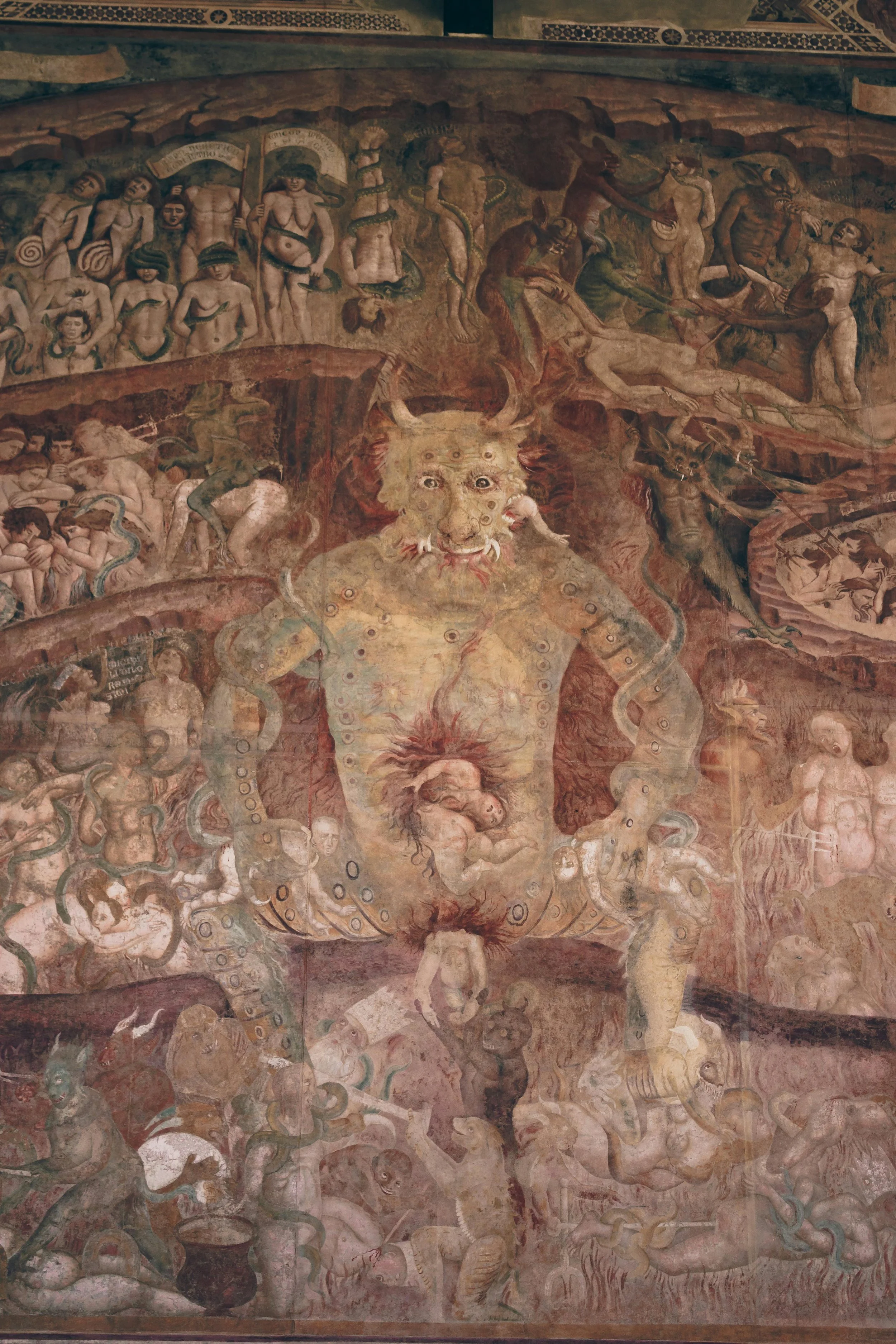
As I write this letter, a storm of emotions overwhelms me. It is hard to believe the time has come for me to say goodbye. Being with you was one of the greatest joys of my life, and I will always cherish the memories we created together. I hope this letter finds you well, my beloved, for there is much to tell about my afterlife in Hell — and what I have learned. Before that, I must speak of the one who inspired me to write you this letter and the lesson his story gave me.
Dante Alighieri (1265–1321), born and raised in Florence, Italy, is one of the most influential poets of the Middle Ages. His epic masterpiece, The Divine Comedy, written in the early fourteenth century, charts the soul’s symbolic journey toward God. The first part, “Inferno”, presents Dante’s descent into Hell. Guided by the Roman poet Virgil, he witnesses the consequences of sin. Drawing on his political exile and spiritual struggles, Dante creates a deeply personal and universally moral vision of the afterlife.
In “Inferno”, Hell is imagined as a vast, funnel-shaped pit beneath the earth, divided into nine concentric circles, each reserved for a particular sin. From the sorrow of virtuous pagans in Limbo to the frozen torment of traitors in the Ninth Circle, the punishments grow harsher the deeper he travels. Each punishment reflects the nature of the sin (contrapasso), reinforcing the theme of divine justice. By weaving together his Florentine background, Christian theology, and vivid imagination, Dante not only crafted a gripping narrative but also offered readers a powerful meditation on morality, justice, and redemption.
source: Damrosch, David, and David L. Pike, editors. The Longman Anthology of World Literature, Compact Edition. Pearson Longman, 2008.
Here is what I have learned about the Nine Circles of Hell through Dante’s journey:
First Circle – Limbo: Virtuous pagans and unbaptized souls are not tortured but live eternally without God’s light.
Second Circle – Lust: Souls guilty of lust are swept violently by endless winds, as passion once swept them from reason.
Third Circle – Gluttony: The gluttonous lie in foul slush under endless rain. Their surrender to appetite brings misery.
Fourth Circle – Greed: Hoarders and wasters roll heavy stones against one another, endlessly clashing.
Fifth Circle – Wrath: In the River Styx, wrathful rage is on the surface while the sullen drowns below.
Sixth Circle – Heresy: Heretics are locked in burning tombs for denying the soul’s immortality.
Seventh Circle – Violence: Violence appears in three forms: murderers in boiling blood, blasphemers on burning sand, and suicides transformed into trees in a dark, thorny forest, tormented by Harpies.
Eighth Circle – Fraud (Malebolge): Fraudsters suffer in ten ditches, each punishment twisted to match their deceit.
Ninth Circle – Treachery: In the frozen lake Cocytus, traitors are locked in ice, with Satan at the center devouring Judas, Brutus, and Cassius.
Of all these circles, the one that stands out most to me is the Second Ring of the Seventh Circle
— the Forest of Suicides. There, souls who took their own lives are trapped as twisted trees in a dark, thorny forest, their branches torn by Harpies. It is darker even than the “dark wood” where Dante began his journey, for here despair is permanent — a forest of pain reflecting the ultimate loss of hope.
My beloved, I am among them. Please do not be saddened or frightened by what I am about to say — my actions brought me here. In this Inferno, this seventh circle, second ring, there is an absolute, crushing quiet; no sound comes from my mouth. When I open my eyes, the world around me is darkness — the sky is as black as a bottomless pit. Tall forms that at first appear as poles reach upward, but when I look closer, I see they are dry, deserted, utterly lifeless trees. Creatures with bird bodies and the faces of women, called Harpies, wheel above, searching to feast on the hollow forest. They pick at the dead branches; the trees respond with a groan and weep blood like tears, as though begging forgiveness for the self-harm they once inflicted on their bodies — bodies God made with care and beauty.
The demons seem deaf and blind to those pleas; their only mission is to inflict, without mercy, the same pain the souls once inflicted on themselves. While I watched, I remembered Dante asking his guide Virgil for permission to speak to a broken branch. With Virgil’s consent, he asked, “What is your story?"
The branch answered: “My name is Jocasta. I am here for a great sin — greater, perhaps, than the sin I committed with my first husband, Laius, and with Oedipus, who was both my son and my husband. The sin of hanging myself has brought me this punishment. Looking closely, you can see a body hanging from the branch like cloth on a hanger. That body is mine. It is there to remind me — and others who commit such sin — that since we rejected our flesh in life, we are denied a fleshly body here in Hell.”
Still, in this place of punishment — this contrapasso — I remember who I once was: someone who could not love or appreciate herself, who hurt herself, and who is now degraded to something without voice or mobility, forced to grovel for eternity.
As an imperfect but still living human, I hope you appreciate who you are and never hurt yourself as I did. Instead of meeting Harpies in your afterlife, I hope you ascend to Heaven, where light and love dwell, as Dante’s beloved Beatrice does.
I am deeply sorry. I send you what love I have left. Remember me kindly.
And, before I go, let me give you this blessing: May your life’s path never stray into the dark forests where I was lost. May you find your own Virgil to guide you, and your own Beatrice to call you upward. May your soul rise where mine has fallen, and may you walk in light, not shadow, until the end of your days.